BEATS CT reconstruction pipeline
Minimal TomoPy reconstruction pipeline for data collected at the BEATS beamline of SESAME
Created on: 23.05.2021
Last update: 09.10.2023
By: Gianluca Iori, 2023
Code license: MIT
Narrative license: CC-BY-NC-SA
Type Ctrl + Enter on a single cell to run it.
Load experiment data
Enter the sample_name and the correct output_dir
sample_name = "bee_yazeed-20231001T170032"
work_dir = "/mnt/PETRA/SED/BEATS/IH/"+sample_name
h5file = work_dir+"/"+sample_name+".h5"

output_dir = "/mnt/PETRA/SED/BEATS/IH/scratch/tmp/"
recon_dir = output_dir+sample_name+"/recon/"
cor_dir = output_dir+sample_name+"/cor/"
Load the complete dataset (or)
# projs, flats, darks, theta = dxchange.read_aps_32id(h5file, exchange_rank=0)
Read a portion of the dataset
sinocontrols the vertical detector lines to read -sino=(1360, 2160, 1)projdefines the range of projections -proj=(1, 1001, 1)
sino=(1360, 2160, 1)
proj=(1, 1001, 1)
projs, flats, darks, _ = dxchange.read_aps_32id(h5file, exchange_rank=0, sino=sino, proj=proj)
theta = np.radians(dxchange.read_hdf5(h5file, 'exchange/theta', slc=(proj,)))

print("Dataset size: ", projs[:, :, :].shape[:], " - dtype: ", projs.dtype)
print("Flat fields size: ", flats[:, :, :].shape[:])
print("Dark fields size: ", darks[:, :, :].shape[:])
print("Theta array size: ", theta.shape[:])
INFO:dxchange.reader:Data successfully imported: /mnt/PETRA/SED/BEATS/IH/bee_yazeed-20231001T170032/bee_yazeed-20231001T170032.h5
INFO:dxchange.reader:Data successfully imported: /mnt/PETRA/SED/BEATS/IH/bee_yazeed-20231001T170032/bee_yazeed-20231001T170032.h5
INFO:dxchange.reader:Data successfully imported: /mnt/PETRA/SED/BEATS/IH/bee_yazeed-20231001T170032/bee_yazeed-20231001T170032.h5
INFO:dxchange.reader:Data successfully imported: /mnt/PETRA/SED/BEATS/IH/bee_yazeed-20231001T170032/bee_yazeed-20231001T170032.h5
INFO:dxchange.reader:Data successfully imported: /mnt/PETRA/SED/BEATS/IH/bee_yazeed-20231001T170032/bee_yazeed-20231001T170032.h5
Dataset size:  (1000, 800, 2560)  - dtype:  uint16
Flat fields size:  (102, 800, 2560)
Dark fields size:  (102, 800, 2560)
Theta array size:  (1000,)
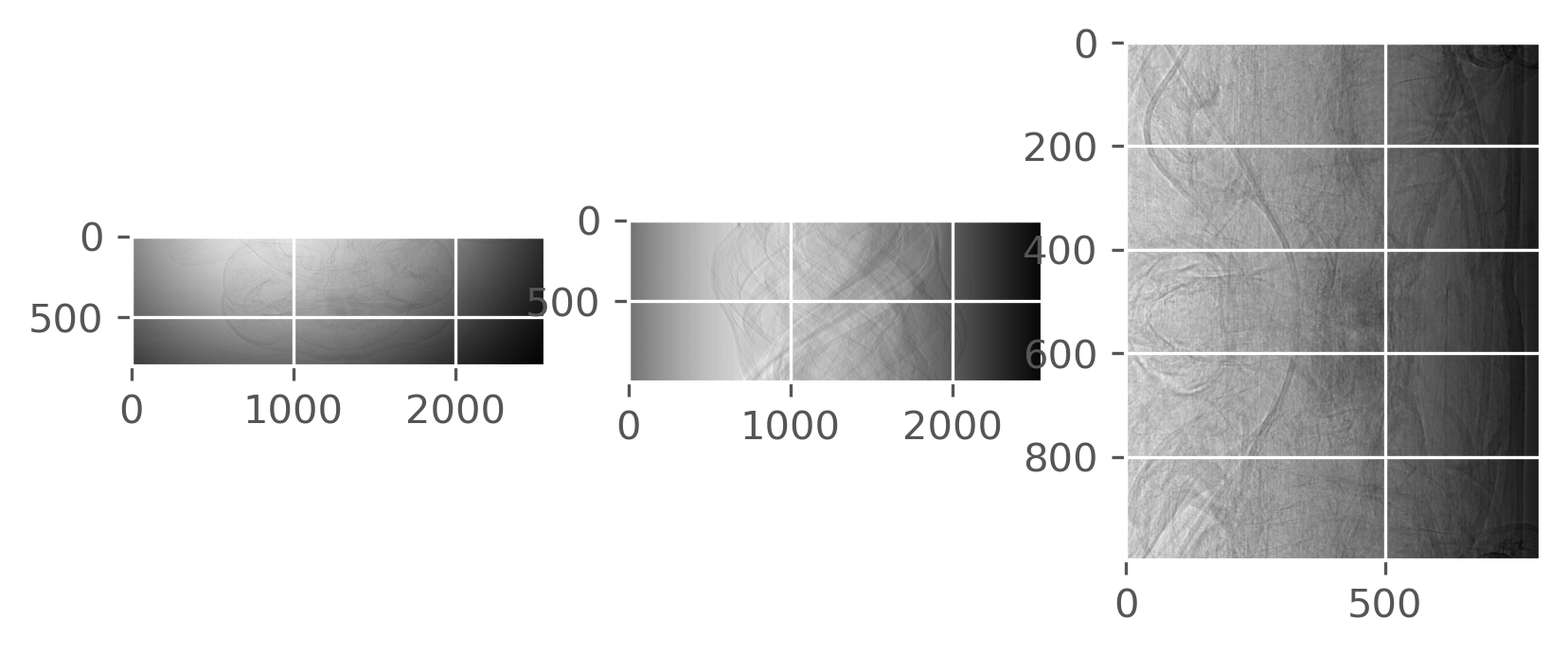
At any time you can take a look at your 3D data with ru.plotmidplanes(data)
ru.plot_midplanes(projs)
Flat field correction
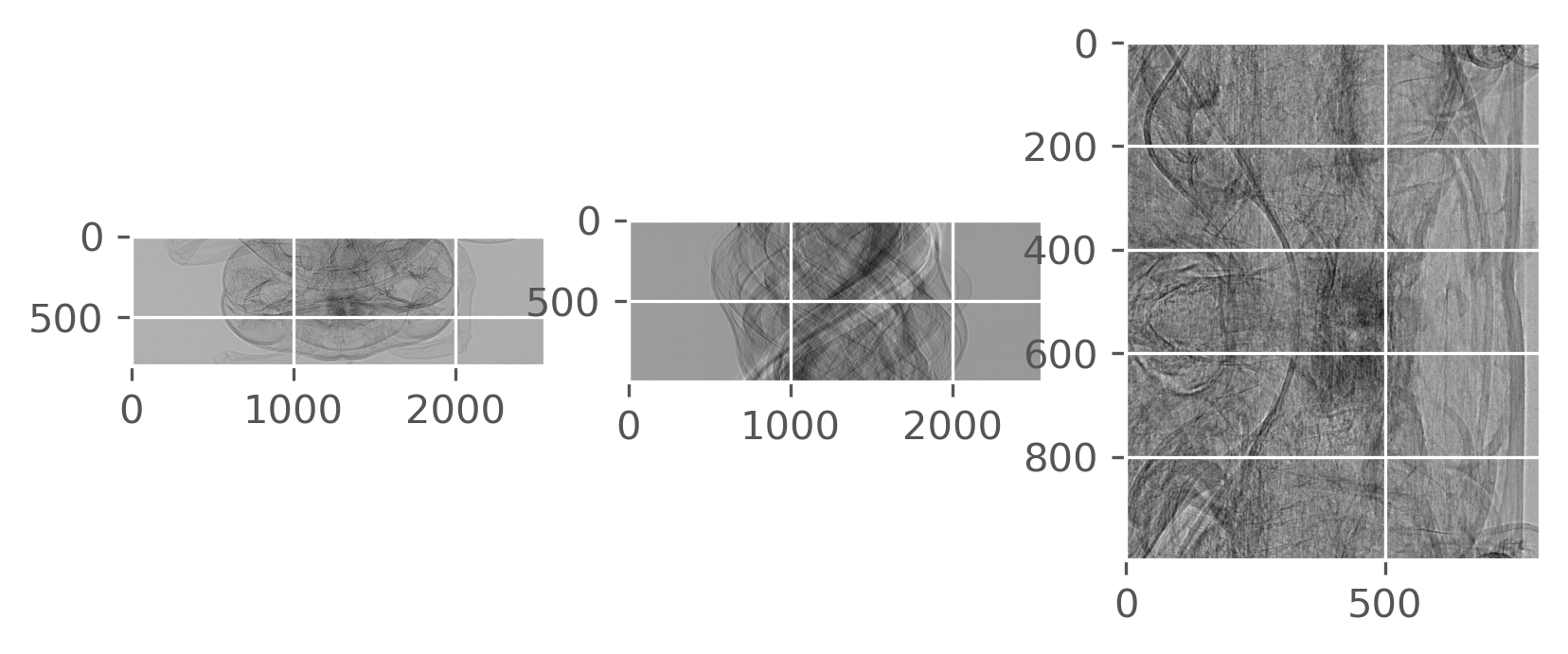
Normalize the image background.
projs = tomopy.normalize(projs, flats, darks, ncore=ncore, averaging='median')
ru.plot_midplanes(projs)
Log transform
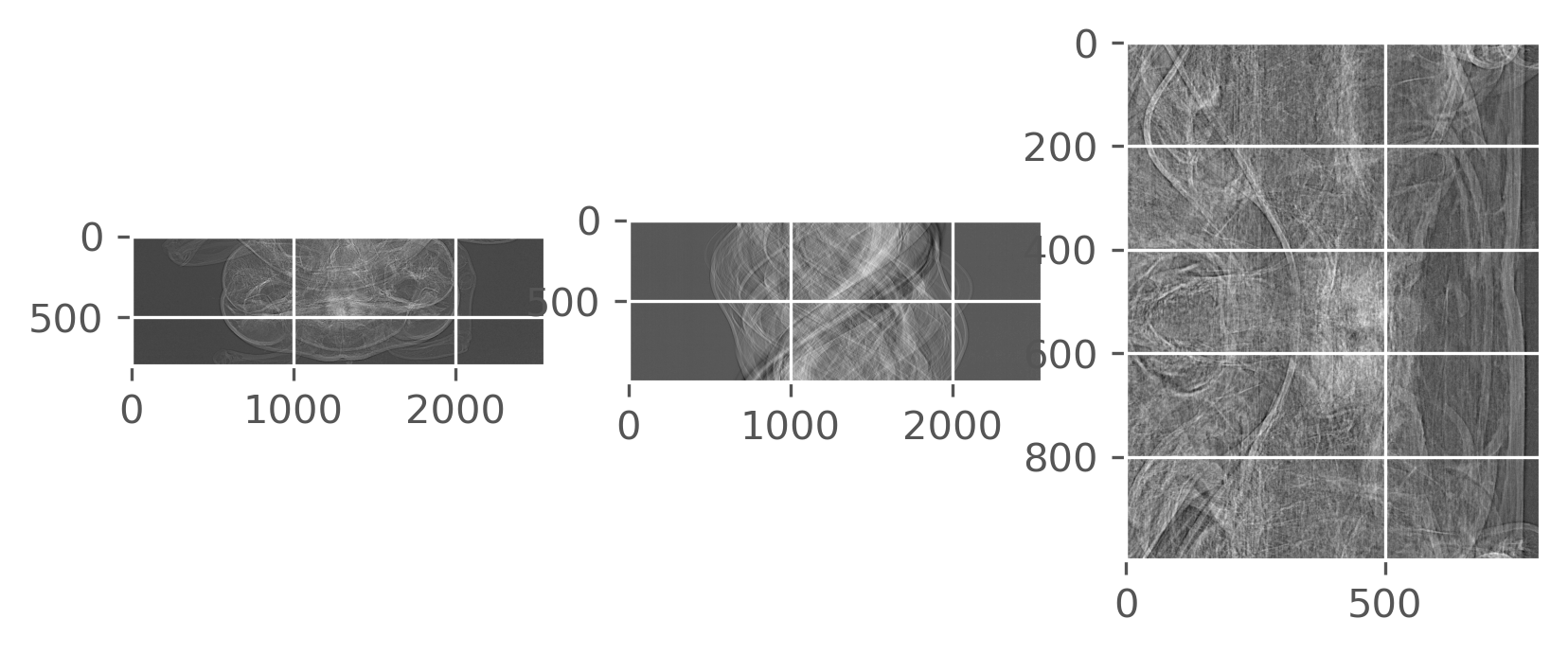
Calculate $ -log(projs) $ to linearize transmission tomography data.
projs = tomopy.minus_log(projs, ncore=ncore)
ru.plot_midplanes(projs)
Center Of Rotation (COR)
Save images reconstructed with COR range
cor_range = [1298, 1304, 0.5]
tomopy.write_center(projs, theta, cor_dir, cor_range)
INFO:tomopy.recon.algorithm:Reconstructing 12 slice groups with 12 master threads...
View them in Fiji
# os.system(Fiji_exe_stack + cor_dir+'{:04.2f}'.format(COR[0])+'.tiff &')
Manually insert the best COR
COR = 1301
Automatic detect COR
# COR = tomopy.find_center(projs, theta, init=projs.shape[2]/2, tol=0.5) # ind=200,
# print("Automatic detected COR: ", COR, " - tomopy.find_center")

COR = tomopy.find_center_vo(projs, ncore=ncore)
print("Automatic detected COR: ", COR, " - tomopy.find_center_vo")
Automatic detected COR: 1301.5 - tomopy.find_center_vo
Reconstruction
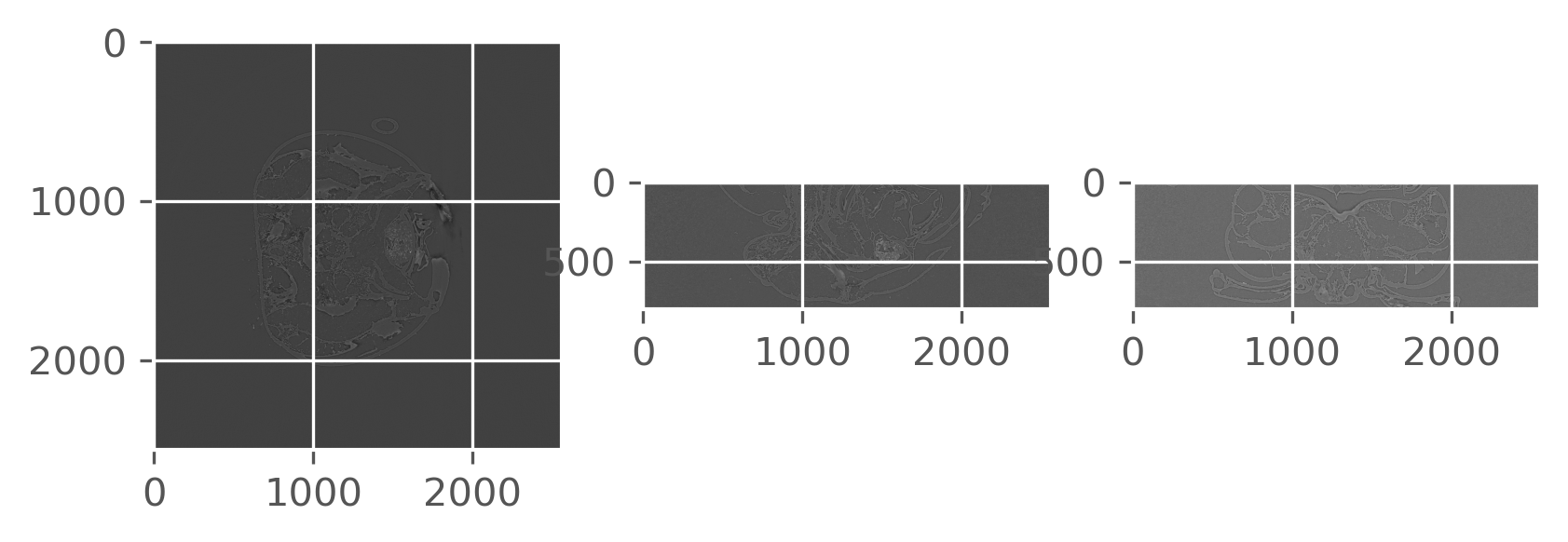
CPU reconstruction of the entire dataset
Algorithm |
|
recon = tomopy.recon(projs,
                     theta,
                     center=COR,
                     algorithm='gridrec',
                     sinogram_order=False,
                     ncore=ncore)
INFO:tomopy.recon.algorithm:Reconstructing 36 slice groups with 36 master threads...
ru.plot_midplanes(recon)
GPU reconstruction with the ASTRA toolbox
Algorithm |
|
# options = {'proj_type': 'cuda', 'method': 'FBP_CUDA'}

# recon = tomopy.recon(projs,
#                      theta,
#                      center=COR,
#                      algorithm=tomopy.astra,
#                      options=options,
#                      ncore=1)
Write reconstructed dataset
Write output tiff stack as float32
fileout = recon_dir+'slice.tiff'
dxchange.writer.write_tiff_stack(recon, fname=fileout, axis=0, digit=4, start=0, overwrite=True)
Open virtual stack in ImageJ
# os.system(Fiji_exe_stack + fileout + ' &')